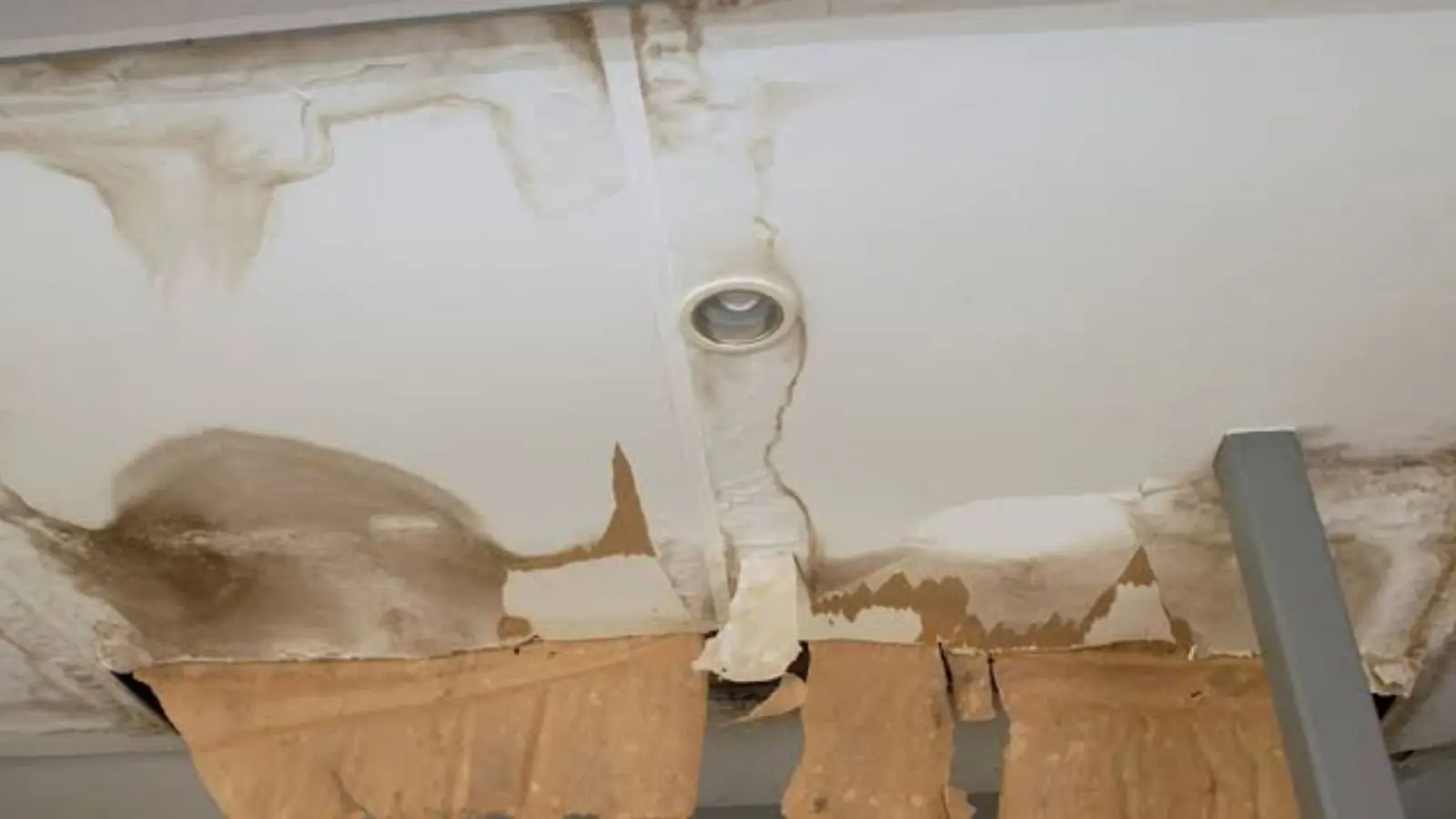
Ceiling damage from water begins as a stain, but the stain is only the visible edge of a bigger problem: water is trapped between the drywall and whatever sits above it. Stop the source if you can, keep people out from under any sagging section, and call a restoration crew before the board lets go, because wet ceiling drywall can fail with no warning.
In Indio the source is usually one of four things. A roof leak after a storm, a supply or drain line serving a bathroom above, a water heater or air handler in the attic, or a condensate line that has backed up. The rest of this guide shows how to tell them apart, what to do in the first hour, and where the line falls between drying a ceiling and replacing it.
Read the stain before you touch it
The color and shape of a ceiling stain carry information. A pale tan ring with a darker edge usually means water arrived, dried and arrived again, which points to a slow leak. A fresh, glossy, spreading patch means water is moving right now. A stain that appears only after rain points at the roof, while one that appears on dry days points at plumbing or an air conditioning line.
Look at where the stain sits. A spot directly under a bathroom suggests a toilet flange, shower pan or supply line. A stain along an exterior wall often follows a flashing or stucco problem. A stain near a hallway ceiling vent or a closet door can mean an air handler drain pan has overflowed. Mark the edge of the stain with a pencil and a time, so you can tell later whether it is still growing.
What the ceiling is telling you
Use this as a first sort. It does not replace a moisture reading, but it helps you decide how urgent the call is.
| What you see | Likely source | How urgent | First move |
|---|---|---|---|
| Dripping or beading water | Active supply line, drain line or roof opening | Emergency | Shut off the main water valve, move belongings, call the 24/7 line |
| Bulge or sag in the board | Water pooled on top of the drywall | Emergency | Stay out from under it and call before it collapses |
| Spreading stain after a storm | Roof leak or failed flashing | Same day | Photograph it, set a bucket, call for extraction and drying |
| Stain under a bathroom | Toilet seal, shower pan or supply line | Same day | Stop using that bathroom and shut off its stop valves |
| Stain near a ceiling vent or closet | Air handler drain pan or condensate line | Same day | Turn off the air conditioner at the thermostat and breaker |
| Dry, tan, ring-shaped stain | Old leak that may have stopped | Soon | Have the area checked with a moisture meter before painting over it |
A dry-looking stain can still hide wet insulation. Only a meter or a thermal camera tells you for sure.
The first hour, in order
These steps protect people first and the building second. Do the ones that are safe and skip the rest.
- Stop the water. Close the main shutoff, or the stop valve for the fixture above, or turn off the air conditioner if the stain is near a vent.
- Look up before you walk. Do not stand under a bulge or a sagging panel, and keep children and pets out of the room.
- Cut power only if you can reach the panel without standing in water. If a light fixture is wet or dripping, leave that circuit off and do not touch the fixture.
- Move furniture and electronics out of the drip zone, and lift rugs so water does not wick into the floor.
- Photograph the stain, the room and any visible source, then write the time on a notepad.
- Call a restoration crew. Describe what is wet, where the water came from and whether it has stopped, so the dispatcher can tell you what to expect.
Why a bulging ceiling is a drain, not a repair
A bulge is water sitting on the back of the drywall with insulation holding it in place. People are often tempted to poke a hole to let it out. That can work, but only when it is done on purpose. Put a bucket and a tarp under the bulge, stand to the side rather than beneath it, and make a small hole at the lowest point so the water leaves in a controlled stream.
Do not do this near a light fixture or where a wire may run through the cavity. If you are unsure, leave it for the crew. A technician can relieve the pressure, remove the wet board in sections and keep the debris off your floor. Either way, the drywall that held the water is rarely worth keeping, since it has lost its strength and often its paper facing.
What drying above the drywall looks like
Once the water stops, the question is what is still wet. A crew uses moisture meters to map the ceiling, the wall tops and the attic floor, and a thermal camera to spot cool, damp areas. Wet fiberglass or blown-in insulation is usually removed, because it holds water for days and slows the drying of everything near it.
Drying equipment then does the work. Air movers push air across the cavity, LGR dehumidifiers pull moisture out of the room, and in some jobs a small opening is cut to let air reach the joists. The goal in the language of the ANSI/IICRC S500 standard is to bring materials back to their normal moisture level, not just to make the surface feel dry. The general process is covered on the water mitigation page.
Why speed matters for ceilings
Wet drywall and insulation stay damp for a long time in a closed cavity. The longer they do, the more likely the board needs replacing and the more likely mold starts. A fast call is usually the difference between cutting out one panel and cutting out the whole room.
Dry it, patch it or replace it
There is no single rule. These are the questions a restoration professional works through on site.
Was the water clean?
Rain through a roof or a broken supply line is treated differently from sewage or an overflowing drain pan. Dirty water means the board and insulation come out.
How long was it wet?
A ceiling that was wet for a day often dries in place. One that has been damp for a week or more usually has soft board and needs replacing.
Is the board sagging or crumbling?
Drywall that has lost its shape has lost its strength. Cut-out and replace is the safer repair.
Is insulation involved?
Wet insulation is removed and replaced in most cases, which means the ceiling below is opened anyway.
Water coming through a ceiling right now? The line is open around the clock.
☎ (760) 769-1159Repair after drying
After the structure is dry, the rebuild is ordinary drywall work: new board, taped and finished joints, stain-blocking primer so the old tint does not bleed through, and paint across the full ceiling plane so the patch does not show. Textured ceilings take extra care to match. The full scope of that work sits under water damage repair.
If the leak was a plumbing line, the fix to the pipe or fixture comes first. If it was the roof, the roofing repair has to happen before new drywall goes up, or the ceiling is wet again at the next storm. A restoration company dries and rebuilds the interior, but a roofer or plumber repairs the source.
Paperwork while the ceiling is open
Insurance usually draws a line between sudden and accidental damage, which is often covered, and slow leaks or neglect, which often are not. Read your own policy or ask your insurer. California Department of Insurance guidance for homeowners says to make temporary repairs to prevent further damage and to keep a log of every call and message with your insurer.
Photos of the stain, the source, the removed material and the readings on the moisture meter all help. Ask the crew for a written scope that lists what was removed and what was dried, and keep the receipts for anything you buy to stop the damage from spreading. If the ceiling is also near a rain-soaked roof, ask the crew to note that as well.
Who to call and what to ask
Start with a restoration crew if water is still moving or the ceiling is wet, because they can extract, dry and open the ceiling safely. Call a roofer or plumber for the repair of the source. If the situation reaches more than a patch, the emergency water removal crew can handle standing water below the ceiling as well.
Ask whether the company explains the scope and price before work starts, whether its crews work to the S500 standard, and whether the contractor holds a license. California requires one for jobs of $1,000 or more under the Contractors State License Board. Those three questions sort out most of the field.
Water damage in Indio: ceiling notes
On September 28, 2026, local TV reported a National Weather Service flash flood warning that included Indio, with flooding reported that night in the Indio Hills area north of the interstate. That was a news report, not a city record, but it is a good reminder that after a hard desert rain, roofs are the first place to look. A stain that shows up the next morning in a bedroom ceiling deserves a call the same day.
The City of Indio storm page advises keeping gutters, downspouts and drains clear, and shutting off electricity at the breaker panel if water rises near outlets. If water is coming through a ceiling, the same caution applies to the light fixtures and outlets near it. The city's Building and Safety Division can confirm whether a larger repair needs a permit, since the city says a permit is required before work begins on projects that are not exempt.
Frequently asked questions
Not until you know the area is dry. Paint over a damp ceiling traps moisture and the stain usually bleeds back through. Have the area read with a moisture meter, fix the source, and use a stain-blocking primer on dry board.
Yes. A sagging ceiling is holding water and its weight can bring the board down. Stay out from under it, turn off the water if you can, and call the 24/7 line. A crew may drain it in a controlled way before removing the board.
It depends on how much insulation and drywall is wet and whether the cavity is closed. Many jobs take a few days of equipment time, and the crew confirms dryness with a meter rather than a guess. Wet insulation is often removed to speed this up.
Often, if the water was sudden and accidental, such as a burst supply line. Slow leaks and neglect are often excluded, and flood damage is generally covered only by a separate flood policy. Check your policy or ask your insurer, and read about water damage repair scopes before you talk to the adjuster.
Yes, even a small one, since desert roofs are tested hard by a few big storms. Look for the stain the morning after, photograph it, and have the roof and the attic checked. A leak that is caught early is usually a patch rather than a ceiling replacement.
If the stain sits near the Coachella side of the valley or further west toward La Quinta, the same advice applies. Crews serve Coachella and La Quinta as well as Indio.