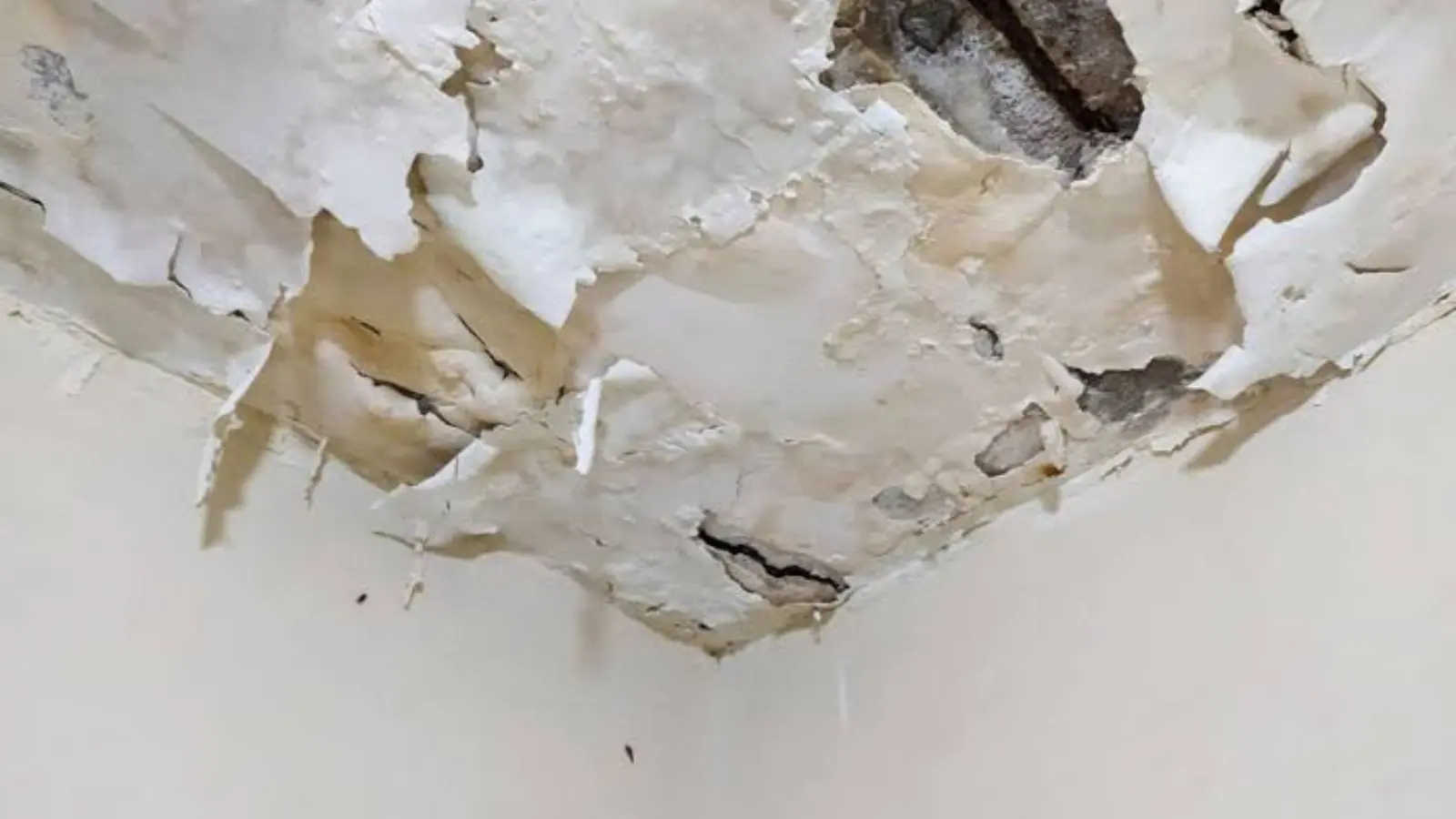
Wet sheetrock can sometimes be dried in place, but it has to be cut out when it is soaked through, sagging, crumbling, exposed to contaminated water or still reading wet after a day or two of drying. The deciding tools are a moisture meter and the source of the water. Clean supply water gives you options. Sewage or floodwater gives you none.
Sheetrock, also called drywall or gypsum board, is a plaster core wrapped in paper. The paper holds water and feeds mold, and the core softens and loses strength when saturated. Repairs fail when someone paints over a damp panel and traps moisture behind it.
This guide covers how to decide between drying and cutting, how a proper repair runs and what to expect from the finishing stage.
Dry it or cut it out: a decision guide
Use this as a starting point. A moisture meter and an on-site look make the final call.
| Condition of the wall | Dry in place? | Cut out and replace? | Reason |
|---|---|---|---|
| Brief wetting from clean water, surface firm, readings near dry within a day or two of drying | Often yes | Only if readings stall | Gypsum and paper can recover when drying starts fast |
| Panel soaked through from a clean supply line, edges soft, paint bubbling | Sometimes, with daily monitoring | Often | Soft board loses strength and may not return to a sound surface |
| Ceiling sagging or bulging with water above | No | Yes, after a controlled drain | Trapped water and weight make collapse possible |
| Contaminated water such as sewage, floodwater or storm runoff | No | Yes | Category 2 and 3 water carries contamination that the paper absorbs |
| Visible mold growth on the face or paper | No | Yes, with containment | Mold on porous paper cannot be wiped away reliably |
| Insulation behind the wall is wet | Rarely | Usually, along with the insulation | Wet insulation holds water against the back of the panel |
How to tell what is really wet
Stains are not moisture readings. A dry stain can look alarming and a wet wall can look fine, because water often travels down inside the cavity and shows up somewhere else. Crews use a pin or pinless moisture meter and a thermal imaging camera to map the wet area, then recheck the same spots each day.
You can do a rough check yourself. Press the wall gently. Firm and cool to the touch is a better sign than soft, warm or crumbly. Tap along the stud line. A dull thud over a hollow sound can mean saturated board. Anything you find, photograph before you touch it again.
The cut-out repair, step by step
- Stop the water and shut off power to the area if outlets or switches are wet.
- Photograph the damage and take moisture readings before cutting anything.
- Remove the baseboard and cut the sheetrock in straight lines above the highest wet reading, so the opening lands on dry material and, where possible, on a stud.
- Remove wet insulation and dry the cavity with air movers and a dehumidifier until the framing reads dry.
- Check the framing and the back of neighboring sheets for staining or mold before closing the wall.
- Hang new sheetrock, tape the seams, apply joint compound in thin coats and sand between coats.
- Prime, texture to match the surrounding wall and paint the full wall to the corner so the repair does not show.
Drying in place when it makes sense
If the wall is firm and the water was clean, technicians can pull moisture out through the cavity. They lift the baseboard, sometimes remove a narrow strip along the bottom to open the cavity, and run air movers with an LGR dehumidifier so the water leaves the room instead of just moving around it.
Drying is monitored day by day, and the decision flips to cutting if readings stall. This is the core of water mitigation, where the goal is to save as much of the structure as can be dried safely.
Not sure whether the wall can be saved? The 24/7 line can walk you through what to check first.
☎ (760) 769-1159Finishing: the part you see
Taping and mudding take patience. Each coat of joint compound needs to dry fully before the next, and the drying time depends on how thick the coat is and how much humid air is in the house. Rushing the coats shows up later as cracks and ridges.
Texture and paint decide whether the repair disappears. Match the existing texture pattern, prime the patch so it does not flash through the paint and paint the whole wall corner to corner. A patch painted on its own almost always shows under raking light. The rebuild stage is covered under water damage repair.
Mistakes that bring the problem back
The most common one is painting over a damp panel. The paint seals moisture in, and the wall stays wet behind it. The second is leaving wet insulation in the cavity because the face of the wall feels dry.
A third is running fans without dehumidification. In a closed house, moving air without removing moisture only relocates it. A fourth is closing the wall before the source is repaired. If a stain keeps returning, the water is still arriving, and sooner or later mold will follow, which is a job for mold remediation.
A bulging ceiling is a safety problem
Keep people out from under a ceiling that sags or bulges and put a bucket beneath the low point. Call so a crew can release the water in a controlled way. If water is still coming from above, start with emergency water removal.
The same logic across the valley
Crews working in Palm Desert and Thermal use the same cut-or-dry test, because the material behaves the same wherever it sits. What changes from house to house is the source of the water and the age of the finish, which is why the on-site readings matter more than any rule of thumb.
Sheetrock jobs in Indio: local notes
Indio Water Authority supplies drinking water in Indio, so a broken supply line usually begins as clean category 1 water. That is the best case for sheetrock, because fast extraction and drying often let the panel stay. Every hour of delay narrows that window.
Sewage is different. Valley Sanitary District serves Indio and surrounding areas for sewer, and a backup is category 3 water. Sheetrock touched by it comes out, whatever it looks like on the surface.
The City of Indio says a building permit is required before work begins, with some exemptions. Ask the Building and Safety Division whether replacing sheetrock after water damage in your home needs one. The city's storm page also advises shutting off power at the breaker panel if water rises near outlets, which applies to any wet wall.
Frequently asked questions
Sometimes. If the water was clean, the panel is still firm and drying starts quickly, moisture readings can return to normal. Soft, sagging, moldy or contaminated sheetrock should be replaced.
It depends on thickness, how much water it absorbed, the humidity in the house and the equipment running. Crews track readings daily rather than relying on a set number of days, and switch to cutting if the readings stop improving.
Yes. Sewage is category 3 water, and the paper face and gypsum core absorb contamination that cannot be cleaned out. Keep people and pets away, stay out of standing water and call the 24/7 line. Valley Sanitary District serves Indio and surrounding areas, so contact it about the public line too.
Only after the source is fixed and the wall reads dry. Painting over a damp panel traps moisture, and the stain will usually return. Stain-blocking primer covers color, not moisture.
The City of Indio says a building permit is required before work begins, with a short list of exemptions, and it does not publish a rule specific to water damage repair. Call the Building and Safety Division to confirm whether your repair needs a permit.