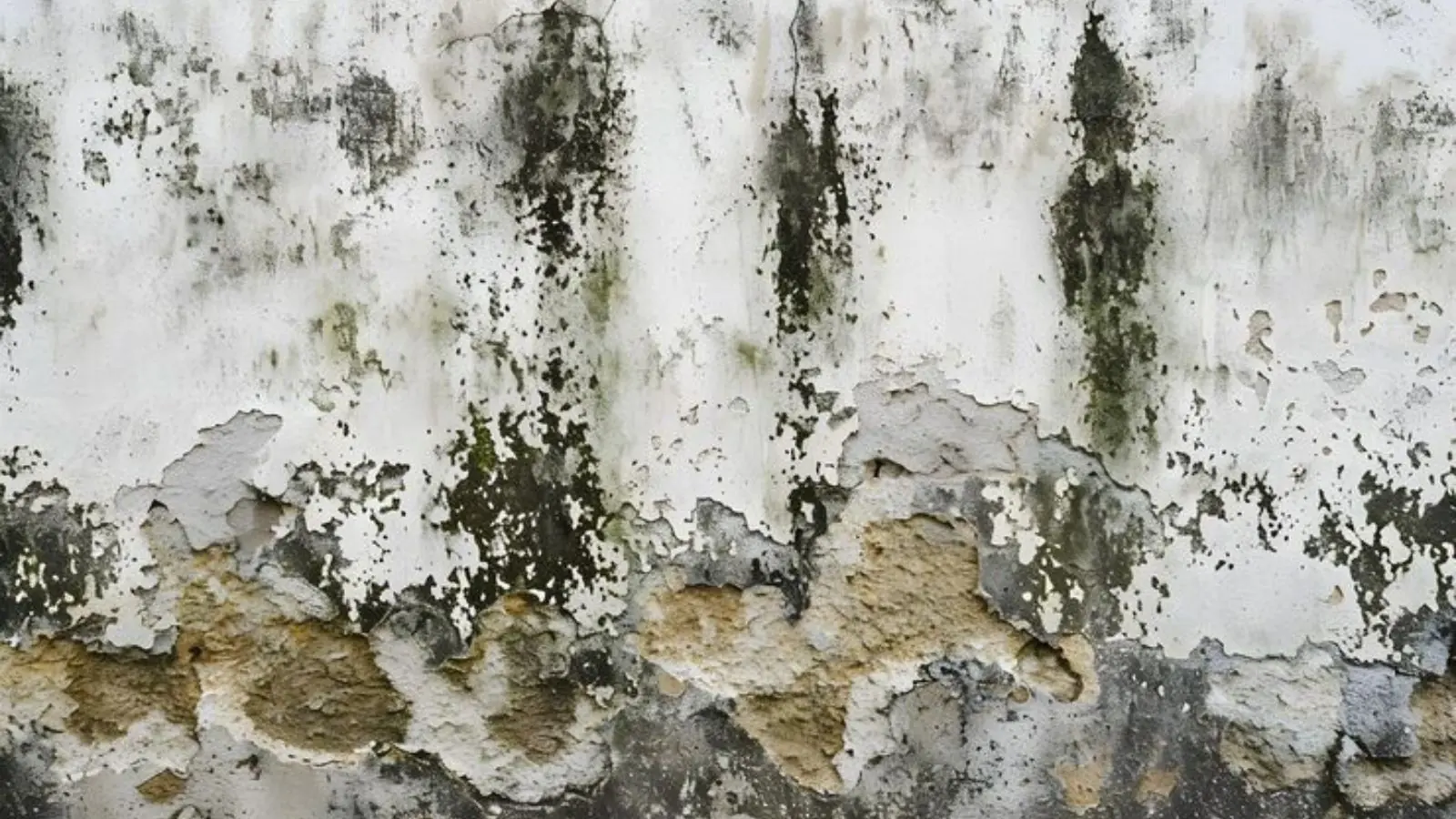
Mold usually looks like fuzzy, speckled or slimy patches in shades of black, green, gray, white or brown. It tends to appear on surfaces that stay damp, such as ceiling corners, the base of walls, grout lines and the backs of cabinets. A musty smell often shows up before the patch does. Because many stains look similar, color alone cannot confirm what you are seeing.
This guide in Indio, CA describes how mold appears on different materials, which look-alikes fool people, what a lab test can and cannot tell you, and what to do before you disturb anything.
Colors and textures, in plain terms
There is no single mold color. Growth can be black, dark green, olive, gray, white, pale yellow or even pink and orange on damp surfaces. Color depends on the type of growth, the material underneath and how long it has been there. That is why people searching for black patches miss the white fuzz in a closet and the green film behind a dresser.
Texture is more useful than color. Look for fuzzy or velvety growth, powdery dusting, slimy film or tight clusters of tiny dots. Mold tends to spread in irregular patches with a feathered edge, often circling out from a damp center. A uniform brown ring with a sharp outline is more likely a water stain from an old leak.
Mold or something else? A comparison
Several things get mistaken for mold, and mold gets mistaken for each of them in return. Use the clues, then confirm with a closer look.
| It may be | How it usually looks | A quick clue |
|---|---|---|
| Mold growth | Fuzzy, speckled or slimy patches, often with a ragged edge | Smells musty, sits where moisture collects and keeps spreading |
| Water stain | Flat tan or brown ring or blotch with a defined outline | No texture, no fuzz and no growth at the edge, and it dried long ago |
| Efflorescence | White crystalline powder or crust on concrete, brick or masonry | Leaves a gritty residue and dissolves with a damp cloth, since it is mineral salt |
| Dirt and soot | Gray or black film that follows airflow, such as above a vent | Wipes off cleanly and has no musty smell |
| Mildew on a surface | Flat white, gray or yellowish film on a damp bathroom or window area | Often wipes away, but it signals moisture that will keep returning |
Looks are only a starting point. Only a close inspection and, where needed, a lab sample can identify what a patch is.
Where mold tends to show up first
Mold needs moisture and a surface to feed on, so its favorite places are predictable. Ceiling corners below a roof leak, the wall behind a toilet, under sinks, along window frames where condensation forms, and the back of cabinets against an exterior wall are common spots. So are closets and furniture pushed tight against a cool wall.
Hidden areas matter just as much. The space inside a wall next to a leaking pipe, the underside of flooring above a damp crawl space and the insulation above a stained ceiling can all hold growth you cannot see. A musty smell with no visible source is a reason to investigate, not a reason to ignore the room.
Clues beyond the color
A musty or earthy smell
A stale, damp-basement odor that is stronger near a wall, closet or vent can mean moisture and growth behind the surface.
Peeling or bubbling paint
Paint lifts when moisture pushes from behind. The bubbles may have growth underneath them.
Warped or soft material
Drywall that crumbles, wood that swells or flooring that cups points to long exposure to water.
Stains that come back
A spot that returns after cleaning or repainting suggests the water source was never fixed.
What a mold test can tell you, and what it cannot
Testing comes in two common forms. A surface sample, taken with a tape lift or swab, tells a lab what is growing on the spot. An air sample compares airborne particles inside with outside air. Each gives a snapshot of one place at one time.
A lab report names the types found and the amount. It does not say where the water is coming from, how far growth has spread behind the wall, or whether an area is safe for any particular person. Those questions need an inspection with moisture readings and, for health concerns, a physician.
Sampling can also be disturbed by the way it is done. Cleaning the area first, running fans or opening windows can change the result. If you plan to test, leave the area as it is and ask whoever collects the sample how it will be done.
Found a patch you cannot identify? Leave it alone and describe it to dispatch so a crew can inspect it.
☎ (760) 769-1159What to do when you find something
- Leave the patch alone. Do not scrub, scrape or sand it, because that releases particles into the air.
- Take clear photos from several distances and note the date.
- Find and stop the moisture source if you can do it safely, for example by closing a valve.
- Keep people and pets out of the room if the patch is large or the smell is strong.
- Call a restoration company that can read moisture, explain the likely extent and describe the next step.
When it is part of a larger problem
Mold is rarely the first problem. It follows a leak, a storm or a slow drip that went unnoticed. If your home recently had a burst pipe, a roof leak or a flood, see how water mitigation works to stop damage in the first days, since fast drying lowers the chance that growth starts.
If growth is already present, mold remediation crews use containment and HEPA filtration so removal does not spread it. The work follows ANSI/IICRC S520, the published standard, and you can ask any company whether its crews follow it.
Homes in Coachella and La Quinta are served from the same dispatch, so the questions above apply no matter where the patch is.
Watching for mold after Indio storms: local notes
Tropical Storm Hilary, which ran August 19 to 21, 2023, damaged an Indio water main by eroding the Coachella Valley Stormwater Channel, according to a FEMA public notice posted by the City of Indio in November 2024. It is a reminder that water events here can be sudden and disruptive. After any storm or pipe break, check ceiling corners, the base of exterior walls and the inside of closets over the following days for new stains or a musty smell.
Local TV reported flash flooding in the Indio Hills area on September 28, 2026, and a National Weather Service flash flood warning that included Indio, according to NBC Palm Springs and KESQ. Those reports described road closures, not damage to homes in the city, but any roof leak or door intrusion after a rain event deserves a look inside the walls if you notice staining.
The City of Indio's storm page also advises residents to keep gutters, downspouts and drains clear, and to shut off electricity at the breaker panel if water rises near outlets. Both steps reduce the amount of water that can end up behind finishes.
Frequently asked questions
No. Dust, soot, old water stains and other deposits can look similar. Mold is more likely when the spot has a fuzzy or speckled texture, a musty smell and a damp source nearby. A closer inspection confirms it.
No. Color does not identify a type, and different types can look alike. A lab sample is the way to identify growth, though the practical response, which is fixing moisture and removing affected material, is often the same.
It is often efflorescence, a mineral salt deposit left when water moves through masonry. It is gritty and not fuzzy. It still tells you moisture is moving through the material, so look for the water source.
You do not have to. An inspection with moisture readings is usually the first step. If you do want testing, ask the person collecting samples how it will be done, and avoid cleaning the area first.