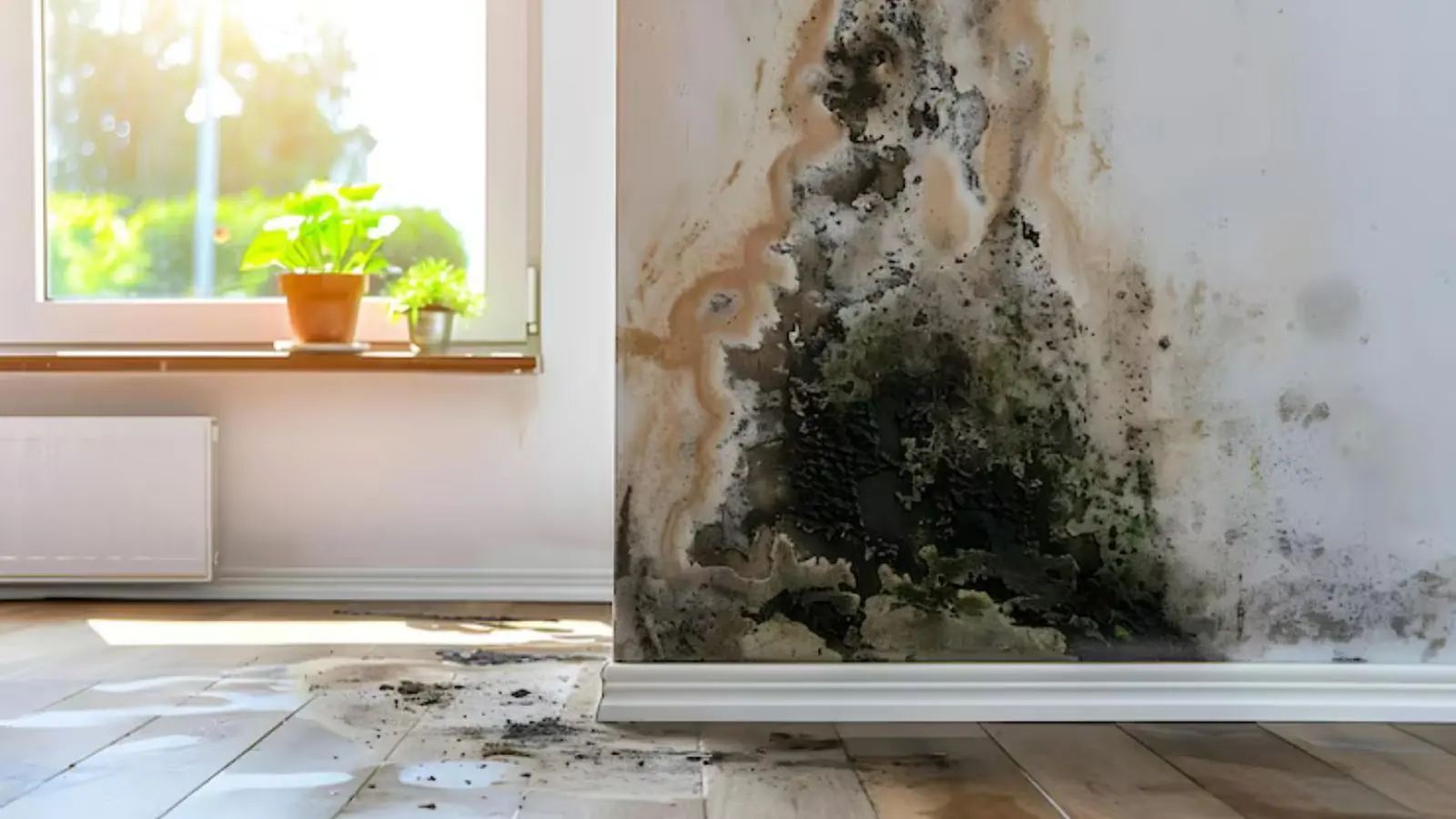
Black mold is a common nickname for dark-colored mold growth, and most often refers to a species called Stachybotrys chartarum that grows on wet paper and wood fiber such as drywall and ceiling tile. The name does not describe a single, reliable category. Many molds look dark, and color alone does not identify what a patch is. Treat any dark growth the same way: find the water, avoid disturbing it and have it assessed.
This guide for homeowners in Indio, CA explains where the name comes from, why it misleads, what to do the day you find dark growth, how professional containment works and where clearance testing fits. It makes no health claims, since questions about symptoms belong to a physician.
Where the name comes from
Stachybotrys chartarum has a dark, slimy appearance and prefers materials rich in cellulose, such as the paper face of drywall, ceiling tile and fiberboard, that stay wet for long stretches. That preference explains why it shows up after chronic leaks or flooding, not after a quick spill that dries by evening.
Popular articles started calling it black mold and the label spread to anything dark. As a result, people use the phrase for patches that are not that species at all. A lab can identify what is growing. A visual guess cannot.
Why the label misleads
Two mistakes follow from the name. The first is panic, where a homeowner assumes every dark patch is a special case. The second is complacency, where a green or white patch is treated as harmless because it is not black. Neither matches the way remediation works.
A standard approach treats mold by cause and extent. Where is the water, what material is affected, and how far has growth spread? Those answers set the scope, and the color of the surface does not. This is also how ANSI/IICRC S520, the published standard for professional mold remediation, frames the work. You can ask any company whether its crews follow it.
What to do when you see dark growth
Use this table to match what you find with a sensible next step. It is a first sort, not a diagnosis.
| What you find | Do this first | Call a professional when |
|---|---|---|
| A small spot on tile, glass or a sealed surface | Fix the moisture, clean with detergent and water, and dry | It returns, or the area is bigger than you thought |
| Dark patch on drywall or a painted ceiling | Leave it alone, photograph it and find the leak | Almost always, since the material is porous |
| Growth on insulation, carpet or ceiling tile | Keep people out and do not disturb it | Always, because these materials usually need removal |
| Growth after flooding or sewage | Stay out of the area and avoid touching anything | Immediately, since contaminated water changes the safety steps |
| Dark growth in the HVAC system or ducts | Turn off the system if it is spreading smell or debris | Always, since air handling can spread particles |
| A musty smell and no visible growth | Look for a leak and moisture behind finishes | If the smell persists or you find damp materials |
The first hour after you find it
Whatever the color, the same short list applies the moment you find growth.
- Do not scrub, brush or sand it, because that sends particles into the air.
- Shut off the water source if you know where it is and can do so safely.
- Keep the area closed off and keep pets and people out if the patch is large.
- Take photographs from near and far, and write down the date.
- Do not run a fan at the patch or spray a cleaner on it.
- Call a restoration company that can inspect and explain the scope.
Do not wait for a color change
The worry about the label can make people delay. The longer a material stays wet, the more of it is affected. Moisture is the common thread, and addressing it early limits what needs to be removed.
How professionals contain and remove dark growth
The work begins with finding and stopping the water. Without that, any removal is temporary. A technician maps moisture with a meter and thermal camera, then seals the work area with plastic sheeting and sets up a HEPA air scrubber so air flows into the zone, not out of it.
Porous materials that carry growth, such as drywall, insulation and ceiling tile, are cut out, bagged and carried out in a way that limits dust. Remaining surfaces are HEPA vacuumed and wiped, then dried. After that the crew rechecks moisture and examines the area to confirm the growth is gone.
That sequence is the heart of mold remediation. When the mold started with a flood or a failed pipe, the drying side of the job is covered under water mitigation, and the order matters, because moisture control has to come first.
Found dark growth and want to know what happens next? Call the 24/7 line before you disturb it.
☎ (760) 769-1159Where clearance testing fits
Clearance testing is a check after removal that the work area is clean enough to rebuild. Some owners hire an independent tester who has no stake in the cleanup to do it, which avoids the appearance that a company is grading its own work. A home sale, a lender or an insurer sometimes asks for a written result.
Ask in advance what the test will measure and what result the tester will accept as passing. A clearance report speaks to the area tested on the day it was tested. It does not predict the future, and it does not replace fixing the water source.
Neighbors and nearby towns
Dispatch from Indio also covers Thermal and Indian Wells. The steps in this guide apply the same way there, whether the dark growth is on a ceiling, under a sink or inside a wall cavity.
Dark mold and your policy in Indio: local notes
The California Department of Insurance says mold damage caused by a covered peril may be covered under a homeowners policy. It also advises policyholders to make temporary repairs to prevent further damage, keep a log of phone calls and correspondence, and never ignore signs of an obvious water problem. Documenting dark growth with photographs before cleanup supports that record.
Under California regulations summarized in the Department's adjuster guide, an insurer generally has 15 calendar days to acknowledge a claim and up to 40 calendar days to accept or deny it after receiving proof of claim. Confirm the current rules with the Department of Insurance or your insurer, since that guide notes the underlying laws take precedence.
California has no state licensing or regulations for mold assessment or remediation, according to the California Department of Public Health, so ask any company about its training, the standard it follows and its contractor license. Indio's Building and Safety Division says permits are required before work starts, with some exemptions, and its pages do not address mold, so ask the division before removing and rebuilding walls.
Frequently asked questions
This site does not make health claims, and no color or label settles that question. Mold of any color should be handled by finding the moisture and removing affected material. Questions about symptoms belong to a physician.
No. Several molds look dark and slimy. Only a lab sample identifies a species, and the practical response is the same whichever one it is.
A small patch on a hard, non-porous surface can be washed with detergent and water while wearing a respirator, gloves and eye protection. Growth on drywall, insulation, carpet or in a large area should be left to a professional crew with containment.
California's insurance department says mold damage caused by a covered peril may be covered. Read your policy or ask your insurer, since the cause of the water matters.
The California Department of Public Health says the state has no licensing or regulations for mold remediators. Ask each company which standard its crews follow, what containment it uses, how it verifies results and whether it holds a contractor license for jobs of $1,000 or more.
Homeowners in Indian Wells and Thermal can put the same questions to dispatch.